The most useful reframe for this problem: you don’t need to keep your dog entertained while you’re at work. You need to tire them out before you leave, so they’re happy to sleep while you’re gone.
A dog that’s had genuine mental stimulation in the morning — a sniff-based game, a food puzzle, a scatter hunt — will settle far more easily than a dog given a toy to deal with alone. Toys have limited appeal to social animals without company. Enrichment activities before you leave change the equation entirely.
Below are 14 ideas, from DIY options that cost nothing to purchased toys worth having. Note that some toys are best used under supervision — not all dogs can safely be left alone with toys, and food toys in multi-dog households should always be supervised.
Why Enrichment Feeding Works
Enrichment feeding uses a dog’s natural foraging instinct to engage their brain at mealtimes. Rather than eating from a bowl in thirty seconds, the dog works for their food — sniffing, problem-solving, pawing, rolling. The mental effort involved is genuinely tiring, often more so than physical exercise.
A dog’s nose processes information at a level that makes sniffing energetically expensive — which is exactly why sniff-based games are so effective at producing a calm, settled dog. Work their nose in the morning and they’ll be far more relaxed for the rest of the day.
More on this in our mental stimulation guide.
DIY Enrichment Ideas
These cost nothing or close to it and can be set up in minutes.

🛠️ DIY Ideas to Try
Treasure Hunt / Scatter Hunt
Scatter your dog’s dry food across the yard or a patch of grass instead of putting it in a bowl. Add a few higher-value treats in harder-to-find spots to keep motivation high. Simple, free, and genuinely effective — especially for food-motivated dogs.
Plastic Bottle Food Toy
Fill an empty plastic bottle with kibble and a few treats, then punch holes in the sides large enough for food to fall out. Remove the bottle top and plastic ring first. Your dog rolls it around to release the food — a free treat ball.
Toilet Roll Stuffing
Smear yoghurt, cream cheese, or peanut butter inside a toilet paper roll, add a few solid treats, and squash the ends closed. Cheap, quick, and can go straight in the bin after.
Doggie Ice Block
Freeze kibble, treats, fruit, or bone broth in an ice cream container or yoghurt tub. Great for hot Australian summers — the melting slows the whole thing down. You can even freeze a Kong or hang a rope out of the block to add difficulty.
Cardboard Box Puzzle
Put treats inside a cardboard box and seal it. Your dog sniffs out the location and works to get inside. Increase difficulty by nesting boxes inside each other, or wrapping treats in paper inside the box.
Marrow Bone
Ask your butcher to cut the ends off large marrow bones. Once your dog has worked out the marrow, wash the bone and stuff the hollow centre with peanut butter, cream cheese, and dry food. Seal the end with peanut butter. Long-lasting and satisfying.
Enrichment Toys Worth Buying

🧩 Toys Worth Having
Kong (Classic)
The classic stuffable rubber toy. Fill with food, seal with peanut butter, and freeze for a longer-lasting challenge. Widely used as a separation aid — a frozen Kong given just before you leave gives your dog something to focus on as you go.
Best for: Everyday use, separation anxiety management, most breeds and sizes
Kong Wobbler (Treat Ball)
Fill with dry kibble and your dog knocks it around to release the food. Some dogs need a demonstration first — show them how it works by rolling it yourself. A household staple that holds up well to regular use.
Best for: Food-motivated dogs, replacing the food bowl entirely
Snuffle Mat
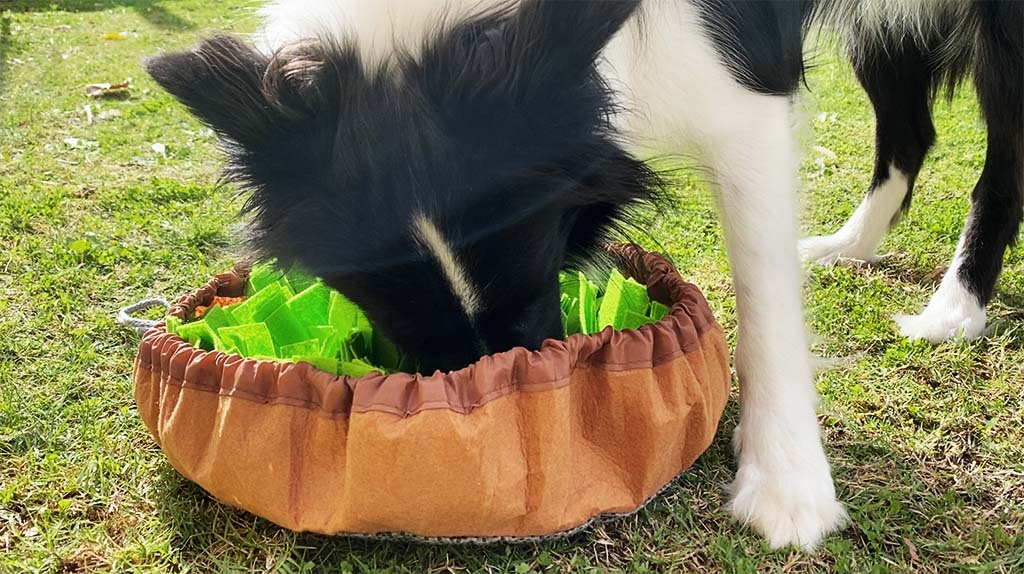
Sprinkle kibble or treats into the fleece fibres and let your dog sniff them out. Engages the nose intensively — most dogs find a snuffle mat more tiring than a walk of equivalent time. Can be made at home or purchased.
Best for: All dogs, especially those who need calm mental work rather than high-energy play
Puzzle Feeders
Boards and trays that require a dog to slide, flip, or lift pieces to reveal hidden food. Available in different difficulty levels — start easy and increase as your dog gets the idea. Frustration is a sign the puzzle is too hard; back down a level.
Best for: Intelligent breeds, dogs that master simpler toys quickly
Sandpit
Bury treats or toys in a sandpit and let your dog dig them out. Rewards digging in one specific location — a useful redirect for dogs that dig in the garden. A clam shell sandpit from Bunnings works perfectly and costs very little.
Best for: Dogs that dig, terrier breeds, dogs that need outdoor enrichment

What to Stuff Dog Toys With
💡 Safe Stuffing Options
Try a range and note what your dog responds to most — preferences vary significantly between dogs. Good options include:
Apples (no core, stem or seeds) · Bananas · Blueberries · Broccoli · Carrots · Cauliflower · Cheese · Cream cheese · Cottage cheese · Cucumber · Eggs · Green beans · Oatmeal · Peanut butter (xylitol-free) · Pumpkin · Salmon · Sardines · Sweet potato · Tuna · Yoghurt
Is Peanut Butter Safe for Dogs?
⚠️ Peanut Butter: Check the Label First
Watch Out for Xylitol
Some peanut butter brands contain xylitol — an artificial sweetener that is extremely poisonous to dogs and can be fatal even in small amounts. Always check the ingredient list and only use peanut butter that contains 100% peanuts. If xylitol, erythritol, or “sugar alcohols” appear on the label, don’t use it for your dog.
High in Fat — Use in Moderation
Even xylitol-free peanut butter is calorie-dense. Treat it as a high-value occasional reward rather than a daily staple — useful for hiding pills, as a Kong stuffer, or as a bath-time distraction. Treats including peanut butter should make up no more than 10% of your dog’s daily calories.

Frequently Asked Questions
❓ Keeping Dogs Entertained FAQ
How long can a dog be left home alone?
Most adult dogs can manage 4–6 hours alone without significant distress. Beyond that, the risk of anxiety, destructive behaviour, and toileting accidents increases. Puppies need much more frequent breaks. If your working day regularly exceeds this, a dog walker or daycare is worth considering.
Why doesn’t my dog play with toys when I’m not home?
Dogs are social — toys are most engaging with company. A dog left alone with a toy it usually ignores it because the motivation to play comes from the social context, not the toy itself. Food-based enrichment (snuffle mats, Kongs, scatter hunts) works better alone because the food reward drives the behaviour independently.
How do you clean dog toys?
For most rubber and plastic toys, rinse with water and scrub with an old toothbrush. For heavy build-up, soak in a solution of one part white vinegar to two parts water. Many rubber toys (including Kongs) are dishwasher safe on the top rack — check the brand’s instructions. Fabric toys can usually go in the washing machine on a gentle cycle.
Is it safe to leave a Kong with a dog home alone?
For most dogs, yes — a correctly sized Kong is one of the safer toys to leave unsupervised. The main risk is using the wrong size (too small) which could become a choking hazard. Always size up if in doubt, and supervise the first few sessions before leaving your dog alone with any new toy.
Can I use these ideas with multiple dogs?
Yes, but food toys in multi-dog households should always be supervised. Even dogs that get along well can become resource-guardy around high-value food items. Feed each dog separately or in different rooms, and don’t leave multiple dogs together with Kongs or food puzzles unsupervised.