
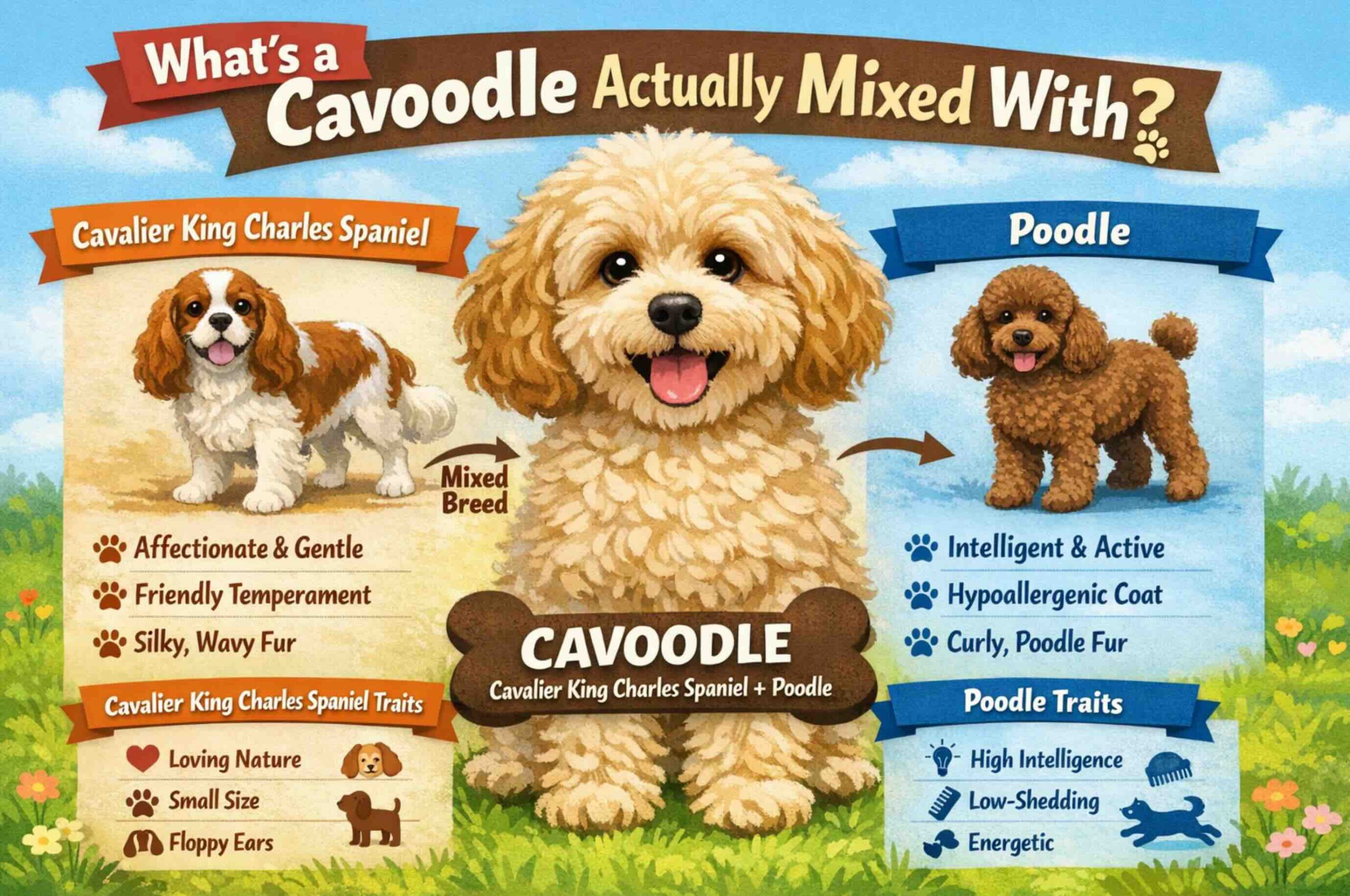
A Cavoodle is a cross between a Cavalier King Charles Spaniel and a Poodle. Also known as a Cavapoo in the US and UK, the Cavoodle name is primarily used in Australia and New Zealand — which makes sense, given that the breed was first developed here in the 1990s.
The cross was intentional — breeders wanted to combine the Cavalier’s gentle, affectionate temperament with the Poodle’s intelligence and low-shedding coat. Here’s what that actually means for the dog you’d be bringing home.
📋 In This Guide
- The Parent Breeds Explained — what the Cavalier and Poodle each bring to the mix
- F1, F1b, F2: What the Generations Mean — why it matters for coat and shedding
- Size, Coat & Appearance — toy vs miniature, colours, and the hypoallergenic question
- Temperament & Personality — what to genuinely expect from the breed
- Health & Lifespan — conditions to know before you buy
- FAQs — cost, allergies, lifespan, and more
💡 Cavoodle at a Glance
- Parent breeds: Cavalier King Charles Spaniel × Poodle
- Also known as: Cavapoo (US/UK), Cavadoodle
- Origin: Australia, 1990s
- Size: Small to medium (depends on Poodle size used)
- Coat: Low-shedding, wavy or curly
- Lifespan: 12–15 years
- Temperament: Affectionate, intelligent, social
- Good for families: Yes
- Good for apartments: Yes
The Parent Breeds Explained
Understanding the parent breeds explains most of what makes Cavoodles the way they are — their temperament, coat, size variation, and health considerations.
🐾 Cavalier King Charles Spaniel vs Poodle
Cavalier King Charles Spaniel
A small companion dog bred to be close to people — gentle, affectionate, and people-oriented. The Cavalier is where the Cavoodle’s warmth, social nature, and strong attachment tendencies come from. They have a silky medium-length coat and expressive dark eyes. Worth noting: Cavaliers are prone to Mitral Valve Disease (a heart condition) and some neurological issues — health considerations that can be inherited by Cavoodles.
Poodle
One of the most intelligent dog breeds in the world, and the source of the Cavoodle’s trainability and low-shedding coat. Poodles come in Toy, Miniature, and Standard sizes — which is why Cavoodle sizes vary depending on which Poodle was used in the breeding. The Poodle’s curly coat produces less dander than many breeds, which is why Cavoodles are often better tolerated by people with mild dog allergies.

F1, F1b, F2: What the Generations Mean
When looking at Cavoodle breeders in Australia, you’ll often see terms like F1, F1b, and F2. These refer to the generation of the cross and affect coat type, shedding level, and predictability.
📊 Cavoodle Generations Explained
| Generation | Parents | Coat | Shedding |
|---|---|---|---|
| F1 | Cavalier × Poodle | Wavy — most variable | Low to moderate |
| F1b | F1 Cavoodle × Poodle | Curlier, more Poodle-like | Very low — best for allergy sufferers |
| F2 | F1 Cavoodle × F1 Cavoodle | Most variable of all | Variable — harder to predict |
If low shedding is a priority — particularly for allergy reasons — an F1b Cavoodle is the most reliable choice. F1 is the most common and generally the most balanced in terms of temperament and coat.
Size, Coat & Appearance
Cavoodle size varies significantly depending on which Poodle was used in the breeding — this is the most common source of confusion when people are researching the breed.
📏 Cavoodle Size Guide
Toy Cavoodle
Bred using a Toy Poodle. Typically weighs 4–6kg and stands around 25–30cm tall. The smallest variety — well suited to apartment living. Toy Cavoodles have become increasingly popular in Australian cities.
Miniature Cavoodle
Bred using a Miniature Poodle. Typically weighs 6–10kg and stands around 30–40cm tall. The most common size in Australia — sturdy enough for families with children while still being manageable in smaller homes.
Coat colours include black, white, apricot, red, tan, and a range of parti-colour combinations. The coat is typically soft and low-shedding, ranging from wavy to curly depending on how much Poodle genetics the individual dog inherits.
💡 On the “Hypoallergenic” Claim
Cavoodles are frequently marketed as hypoallergenic — and while they do shed significantly less than many breeds, no dog is truly hypoallergenic. Allergies are caused by a protein in dander, saliva, and urine — not just fur. Cavoodles, particularly F1b generations, produce less dander than many breeds. But if you have severe dog allergies, spend time with a Cavoodle before committing.
Temperament & Personality
The Cavalier × Poodle cross produces a dog that’s genuinely easy to live with — affectionate without being demanding, intelligent without being difficult, and social without being hyperactive. Cavoodles are excellent family dogs, good with children and other animals, and adapt well to a range of living situations including apartments.
The main temperament consideration that comes directly from the mix is their people-orientation. Both parent breeds were bred to be companion dogs, which means Cavoodles need company. Separation anxiety is common in the breed — more so than in many others — and is worth factoring in if you work full time. Their Poodle intelligence also means they need mental stimulation alongside physical exercise, and they’re highly responsive to training.

Image: Marcus Hodge on Unsplash
Health & Lifespan
Cavoodles typically live 12–15 years. As a crossbreed they benefit from hybrid vigour — mixed breeds tend to be healthier than their purebred parents on average — but they can still inherit conditions from either side.
⚠️ Health Conditions to Be Aware Of
Mitral Valve Disease (MVD)
A heart condition common in Cavaliers that Cavoodles can inherit. Responsible breeders should provide cardiac health clearances for both parent dogs — ask specifically about this before purchasing.
Syringomyelia
A neurological condition associated with the Cavalier breed, caused by the skull being too small for the brain. Less common than MVD but worth being aware of. Reputable breeders should screen for this.
Progressive Retinal Atrophy (PRA)
An inherited eye condition that can cause progressive vision loss, inheritable from either parent breed. DNA testing can identify carriers — ask whether parent dogs have been tested.
Ear Infections
Cavoodles have floppy ears that reduce airflow to the ear canal, making them prone to infections. Regular ear checks and cleaning — especially after swimming — reduces the risk significantly.
💡 Choosing a Responsible Breeder
Given the health risks above, choosing a breeder who health-tests their parent dogs matters. A responsible Cavoodle breeder should provide clearances for cardiac conditions (MVD), eyes (PRA), and ideally hips. Be cautious of breeders who can’t provide documentation, won’t let you see the parent dogs, or seem focused on volume over welfare.

❓ Cavoodle FAQs
What is a Cavoodle mixed with?
A Cavoodle is a cross between a Cavalier King Charles Spaniel and a Poodle. The Poodle used is typically Toy or Miniature sized, which is why Cavoodles vary in size. The breed was first developed in Australia in the 1990s.
What’s the difference between a Cavoodle and a Cavapoo?
They’re the same dog. Cavoodle is the name used in Australia and New Zealand; Cavapoo is used in the US and UK. Both refer to a Cavalier King Charles Spaniel × Poodle cross.
Are Cavoodles really low-shedding?
Generally yes — Cavoodles shed significantly less than most breeds. The degree varies by generation: F1b Cavoodles (backcrossed with a Poodle) have the curliest, lowest-shedding coats. F1 Cavoodles are more variable — some shed very little, others a moderate amount.
Are Cavoodles good for people with allergies?
Many allergy sufferers find Cavoodles more tolerable than other breeds due to their low-shedding, low-dander coats — particularly F1b generations. However no dog is truly hypoallergenic. If allergies are a concern, spend time with a Cavoodle before committing.
How much does a Cavoodle cost in Australia?
Prices from reputable breeders typically range from $3,000–$7,000 depending on generation, coat colour, breeder, and location. Be cautious of unusually cheap Cavoodles — they may come from operations without proper health testing.
How long do Cavoodles live?
Cavoodles typically live 12–15 years. Choosing a breeder who health tests parent dogs — particularly for Mitral Valve Disease — significantly improves the odds of a long, healthy life.
Is a Cavoodle Right for You?
The Cavalier × Poodle cross produces one of the most consistently well-rounded companion dogs available — friendly, trainable, adaptable, and low-shedding. The main things to go in aware of are their need for company (separation anxiety is common), their grooming requirements, and the importance of choosing a breeder who health tests for the Cavalier’s known conditions. Get those right and you’ll have a genuinely wonderful dog.